
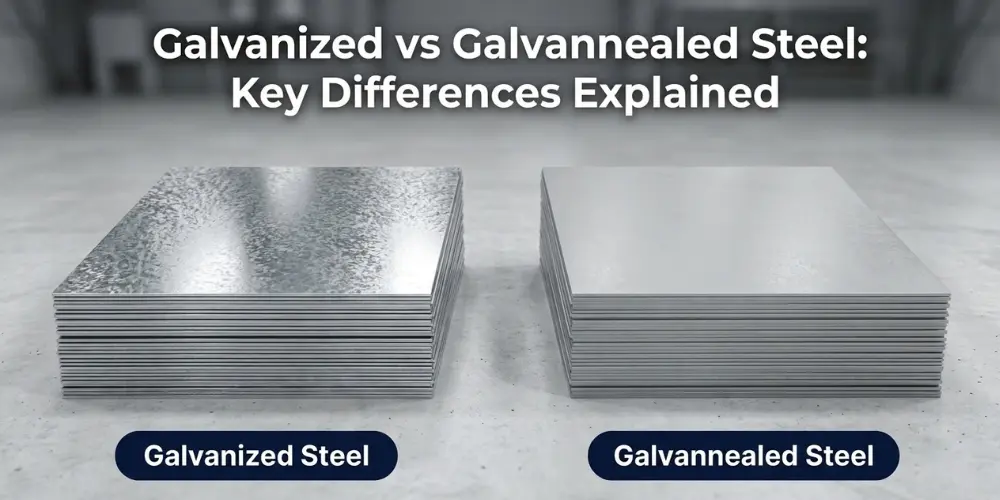
If you have ever priced out coated steel coil, you have probably come to know two terms that get used almost interchangeably: galvanized and galvannealed. Both start identically: dipped in the same bath of molten zinc. But galvannealed steel gets one extra step right after. It goes through a furnace that changes how the coating looks and takes paint.
Understanding galvanized vs galvannealed steel matters because picking the wrong one shows up fast, in the form of primer that won’t bond or a coating that starts rusting years ahead of schedule. That is why we have put together this guide. It explains what makes each one different, how each is produced, and how to know which one your next project actually needs.
What Is Galvanized Steel?
Galvanized steel is a carbon steel coated with a layer of pure zinc to protect it from rust and general corrosion. The most widely used method to prepare this coating on steel is hot-dip galvanizing. In this method, a cleaned steel coil is dipped into a bath of molten zinc that is heated to roughly 850°F. As the steel exits the bath, the zinc solidifies on the surface, forming a tough, adherent metallic layer that most people recognize instantly from fence posts and rooftop ductwork.
Composition and Coating Structure
The coating on standard galvanized steel is almost entirely pure zinc (generally 99% or higher) with only a very thin transitional layer where the zinc and steel metallurgically bond. The material is often referred to as zinc-coated steel in technical specifications and mill documentation because the outer layer remains elemental zinc rather than further alloying with iron.
This pure zinc layer serves a dual purpose. It forms a physical barrier against moisture and provides sacrificial (cathodic) protection. This means the zinc corrodes first if the coating gets scratched, shielding the exposed steel underneath.
Appearance and Surface Finish
Galvanized steel has a bright and reflective surface with a distinct spangle pattern. That pattern is like flower-like crystals that form as the zinc cools and solidifies at its own pace. That spangle is not just cosmetic. It is a visual signature of the pure zinc structure and one of the fastest ways to identify standard galvanized sheets on a shop floor.
Coating thickness is usually specified in ounces per square foot or microns. Thicker coatings generally translate directly into a longer service life before the underlying steel is exposed to the elements.
The global scale of this material is hard to overstate. Grand View Research estimates the worldwide galvanized steel market was worth $267.6 billion in 2026 and projects it will reach $414.6 billion by 2033, growing at a 6.5% compound annual rate.
What Is Galvannealed Steel?
Galvannealed steel starts like galvanized steel. However, there is one step that distinguishes galvanized steel from galvannealed steel. Right after the coil exits the zinc pot, galvannealed steel is sent into an annealing furnace. That furnace usually runs between 900°F and 1050°F. This extra heat step is what makes galvannealed steel different. It changes the coating’s chemistry and behavior compared to galvanized steel.
Composition and Coating Structure
Iron atoms from the base steel move up into the zinc layer while galvannealed steel stays hot inside the furnace. The result is a zinc‑iron alloy coating. This coating usually contains 8% to 12% iron. It is composed of distinct intermetallic phases rather than a single uniform layer of pure metal. This alloyed structure is why galvannealed steel behaves differently from plain galvanized steel when it is welded or painted.
Appearance and Surface Finish
The annealing step breaks up the crystal structure and gives galvannealed steel a flat and non‑reflective matte gray finish. There is no shine and no visible flower pattern. That dull look is not a defect. It is actually a feature because the alloyed surface lets primers and paints grip mechanically instead of sliding off a smooth zinc layer.
Difference Between Galvanized and Galvannealed Steel
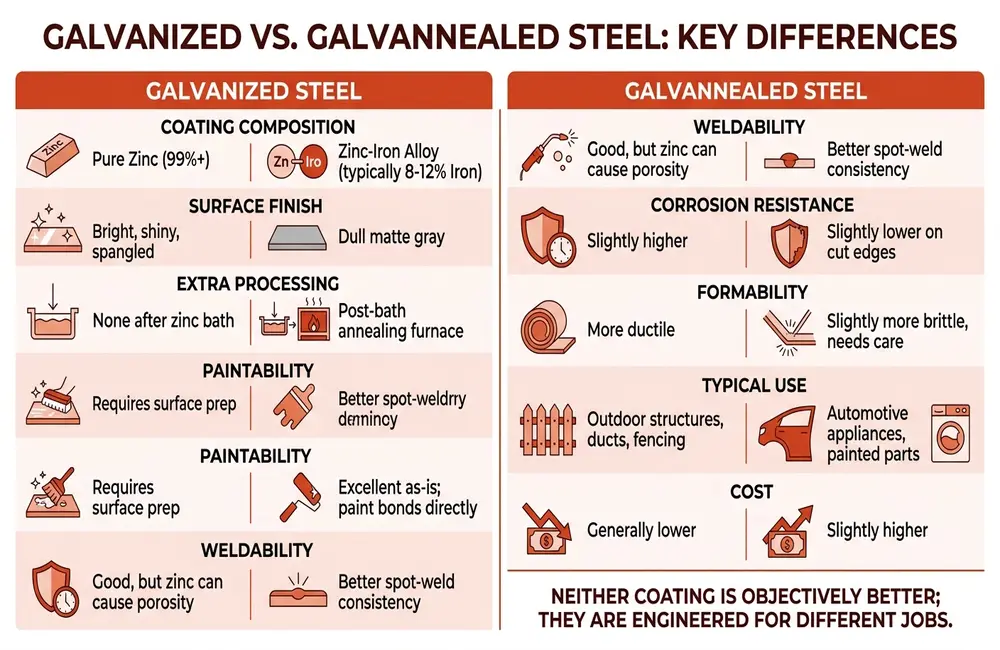
The difference between the two steels ultimately comes down to one furnace pass. Choosing between galvannealed vs galvanized is less about which coating is superior and more about matching the coating’s behavior to what happens to the part next.
The table below lines up the two side by side.
Feature | Galvanized Steel | Galvannealed Steel |
| Coating composition | Pure zinc (99%+) | Zinc-iron alloy (typically 8–12% iron) |
| Surface finish | Bright, shiny, spangled | Dull matte gray |
| Extra processing step | None after the zinc bath | Post-bath annealing furnace |
| Paintability | Requires surface prep | Excellent as-is; paint bonds directly |
| Weldability | Good, but zinc can cause porosity | Better spot-weld consistency |
| Corrosion resistance (bare) | Slightly higher | Slightly lower on cut edges |
| Formability | More ductile | Slightly more brittle, needs care in tight bends |
| Typical use | Outdoor structures, ducts, fencing | Automotive panels, appliances, painted parts |
| Cost | Generally lower | Slightly higher due to added process |
Neither coating is objectively better; they are engineered for different jobs. Parts that stay unpainted and take a beating outdoors do best with plain galvanized steel. Parts headed straight into a paint booth or an automated weld cell almost always perform better as galvannealed.
The Galvanizing and Galvannealing Process Explained
To really understand galvanized vs. galvannealed steel, it helps to walk through the manufacturing process because almost every performance difference between the two traces back to what happens after the zinc bath.
Step-by-Step Process for How Galvanized Steel Is Made
- Surface Cleaning: The coil is degreased in an alkaline bath and pickled in acid to remove oil and other residues, leaving bare metal.
- Fluxing: A flux solution is then applied to prevent oxidation before the steel reaches the zinc bath.
- Hot-dip Coating: The steel is submerged in a bath of molten zinc. The temperature of this zinc is typically around 850°F. In this furnace, the zinc reacts with the iron surface just enough to form a thin bonding layer, then builds up as pure zinc on top.
- Cooling and Finishing: At this stage, air knives wipe excess zinc to control coating thickness. Then the coil is cooled naturally so the zinc solidifies into its characteristic spangled crystal pattern.
At no point in this sequence is the coating reheated after it leaves the zinc bath, which is exactly why the finished product keeps its softness and gives a bright look.
Step-by-Step Process to Prepare Galvannealed Steel
- Surface Cleaning and Fluxing: This step is identical to the galvanized process above.
- Hot-dip Coating: After cleaning and fluxing, the coil passes through the same molten zinc bath under the same conditions.
- Immediate Annealing: Rather than cooling naturally, the coil is fed directly into an annealing furnace heated to roughly 900°F–1050°F while the coating is still soft.
- Iron Diffusion: At this temperature, iron atoms migrate from the base steel into the zinc layer, reacting to form multiple zinc-iron intermetallic phases.
- Controlled Cooling: The coil is cooled under tightly managed conditions to lock in the alloy structure and hit a target iron content, usually 8% to 12%.
Why the Extra Furnace Step Matters
This single furnace pass is the entire difference between the two materials. Mills control furnace temperature and dwell time down to a few degrees because even a small shift in iron content can push the coating toward excessive brittleness or poor paint adhesion.
Get that step wrong, and the sheet can develop a condition called “coating powdering,” where the alloy flakes off during forming, or “flaking,” where larger chunks separate from the base steel entirely; both are among the most common quality complaints mills deal with on galvannealed orders.
Quality control teams typically check finished coils for both coatings using a combination of coating weight testing and visual spangle inspection for galvanized products. Because galvannealed steel has no spangle to visually confirm coating uniformity, mills rely more heavily on X-ray fluorescence testing to verify iron content stays within spec across the width of the coil. This is one more reason galvannealed production runs slightly slower and costs slightly more than standard galvanizing lines.
Zinc pricing adds another layer of complexity to both processes, since the raw zinc bath is the shared starting point for each. Mordor Intelligence reported that in the first quarter of 2026, zinc prices averaged between $3,280 and $3,650 per ton, a 12% to 18% year-over-year jump that compressed galvanizer profit margins by 200 to 300 basis points.
That kind of swing hits galvanized and galvannealed coil pricing almost equally, since the extra cost of galvannealed comes from the added furnace step, not from a separate raw material.
Galvanized Steel Properties versus Galvannealed Steel Properties
Once you know how each coating is created, the differences in the properties of steel and galvannealed steel become much easier to understand. Each one comes from whether the coating remained zinc or became a zinc-iron alloy.
Look at the differences between the properties of these two types of steel.
Corrosion Resistance
Pure zinc is naturally more resistant to corrosion when unpainted than a zinc-iron alloy. The main reason for this resistance is that it takes longer for the environment to wear away a thicker layer of pure metal than a thinner one. Galvanized steel’s softer coating also tends to heal scratches better, as the surrounding zinc gives itself up to protect the steel around the damaged area.
Galvannealed steel’s alloy coating offers less corrosion resistance when it is not painted, especially at cut edges and sheared surfaces where the alloy layer is fully exposed. This is one reason it is rarely left unpainted in situations. In practice, this difference matters most in cases like a galvanized fence post left unpainted for thirty years, which will usually last longer than an unpainted galvanized panel in the same place, even though both started with a similar total amount of zinc.
Surface Hardness and Durability
The zinc-iron alloy layer on steel is much harder than the pure zinc coating on galvanized steel. The intermetallic layers formed during annealing are naturally more rigid than flexible zinc.
That hardness makes galvannealed sheets more resistant to scratches and damage during moving and transportation. This is a benefit in big factories that move thousands of panels every day. That same hardness makes the coating more fragile overall when you start bending or shaping the material into a final form.
Weldability
Galvannealed steel’s weldability is one of its key advantages, especially in high-volume welding used in car manufacturing. The zinc-iron alloy has a higher melting point and more stable surface resistance than pure zinc, which means less zinc melts out during welding and longer intervals between cleaning the electrodes.
Regular galvanized steel can be welded too. The softer pure zinc coating is more likely to pollute the weld area and cause holes, especially at the fast speeds car lines operate at. This one feature is often the reason for factories using automated welding machines all day long.
Paint Adhesion
Pure zinc surfaces on steel are naturally smooth, which can make it harder for paint to stick unless the surface is first treated with a phosphate conversion coating. Steel’s rougher, alloyed surface gives paints and coatings something to stick to right off the factory line, so e-coat and paint adhesion is usually stronger, with less treatment needed.
This is the reason why car and appliance factories choose galvannealed for anything going into a paint area. Skipping or reducing a treatment step later in the process can offset most of the coating’s cost over time.
Formability and Bend Performance
Galvanized coatings are more flexible and tend to move with the base steel during draws and tight bends without breaking. That is why drawn parts and complicated shapes often use plain galvanized coils. Galvannealed coatings can get cracks or visible white powder at sharp bends if the tools and lubrication are not set up properly.
Factories changing from galvanized to galvannealed coil often need to adjust die distances and lubrication times to protect the coating during shaping, because a coating problem at this stage can cause issues later in the process.
Standards and Coating Weight Designations
Both materials are covered under ASTM A653/A653M, the standard specification that governs zinc-coated (galvanized) and zinc-iron alloy-coated (galvannealed) sheet steel produced by the hot-dip process. This is the spec that most purchase orders use, so it is worth knowing how the two coatings are labeled on paper.
Galvanized coatings are marked with a “G” designation, such as G60 or G90, where the number refers to the total coating weight in hundredths of an ounce per square foot on both sides combined.
Galvannealed coatings use an “A” designation, such as A40 or A60, following the same weight-based logic but referring to the zinc-iron alloy layer rather than pure zinc. A higher number means a thicker coating and, generally, longer service life before red rust sets in.
Designation | Coating Type | Typical Coating Weight | Common Use |
| G60 | Galvanized | 0.60 oz/ft² total | Light-duty indoor parts |
| G90 | Galvanized | 0.90 oz/ft² total | Outdoor structural and roofing panels |
| A40 | Galvannealed | 0.40 oz/ft² total | Automotive exposed panels |
| A60 | Galvannealed | 0.60 oz/ft² total | Automotive structural and unexposed panels |
Buyers who skip checking the coating designation on a mill certificate sometimes end up with a part that technically matches “galvanized” or “galvannealed” in name but falls short on the actual zinc weight their application needs. Always match the designation to your corrosion and warranty requirements, not just the coating name.
Cost and Industrial Applications
Cost and application go hand in hand with these two materials, since the extra processing behind galvannealed steel shows up directly in what it is used for and what it costs to specify.
In this section, we will discuss the cost differences and uses of these steels.
Cost Differences Between the Two Coatings
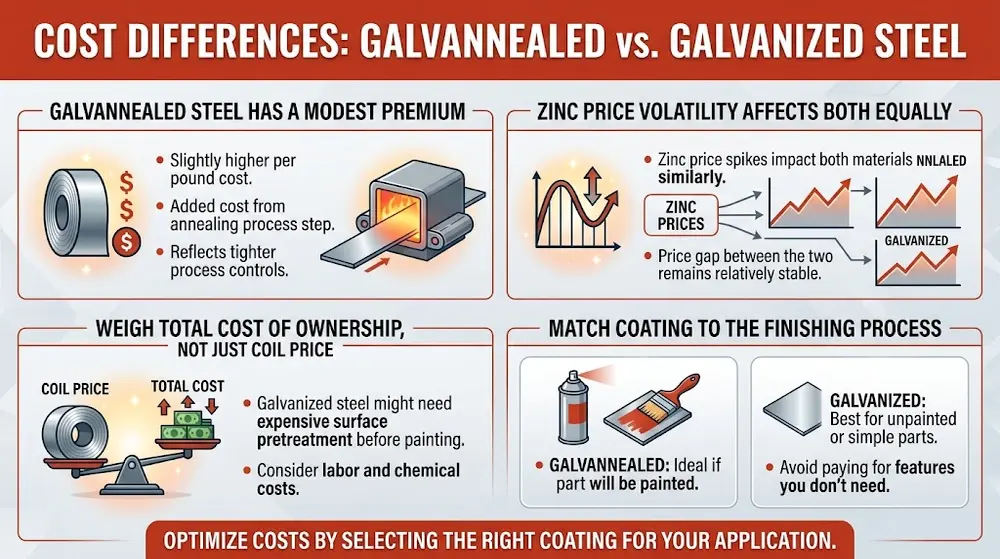
Galvannealed steel typically carries a modest price premium over standard galvanized steel of the same gauge and grade, usually a few cents per pound. That premium comes entirely from the added annealing furnace step and the tighter process controls needed to hit a consistent iron content.
Both coatings start from the same bath. Zinc price volatility, as the spike reported for early 2026, affects both materials in roughly the same proportion, so the price gap between the two coatings tends to stay fairly stable even when raw zinc costs swing.
Buyers should also weigh total cost of ownership rather than just the per-pound coil price. A part specified in plain galvanized steel that ends up needing extra surface pretreatment before painting can quickly erase any upfront savings once labor and pretreatment chemicals are factored in.
On the other hand, paying the galvannealed premium on a part that will never see paint or a weld cell is money spent for no real benefit, since its slightly lower bare corrosion resistance offers nothing extra in that scenario. The smartest buyers match the coating to the finishing process first, then let the coil price follow from that decision.
Where Galvanized Steel Is Used
Standard galvanized steel is used wherever a part remains unpainted and requires long-term outdoor durability. Fortune Business Insights notes that the hot-dip galvanized segment is projected to capture roughly 33.82% of the total galvanized steel market in 2026, driven largely by ongoing construction and infrastructure demand.
Here are the industrial uses of galvanized steel.
- Galvanized steel sheet and galvanized steel coil are staples in roofing panels and metal framing.
- These are used in plumbing, chain-link fencing, scaffolding, and agricultural irrigation systems.
- These are valued for holding up against weather without any paint job at all.
- Guardrails, culverts, transmission towers, and utility poles round out the list of heavy structural uses in which the sacrificial zinc coating needs to survive unattended for thirty years or more.
Uses of Galvannealed Steel
Below are the uses of galvannealed steel.
- Galvannealed steel automotive applications make up the largest single use case for this coating, since car bodies need both strong corrosion resistance and flawless paint adhesion after high-speed spot welding.
- Doors, hoods, fenders, and structural body panels are commonly specified in galvannealed steel coil and galvannealed steel sheet for exactly this reason, and nearly every major automaker uses galvannealed somewhere in its body-in-white construction.
- Appliance manufacturers follow a similar logic, using galvannealed sheet for washer and dryer housings, refrigerator panels, and other painted enclosures where a smooth, factory-applied finish matters to the end customer.
- Electrical equipment makers also reach for galvannealed sheets on switchgear boxes and control cabinets that need a clean, paintable exterior.
Galvannealed vs Galvanized: How to Choose
When you are staring at a spec sheet trying to decide galvannealed vs galvanized, ask these three questions first:
- Will the part be painted? If yes, galvannealed almost always wins on adhesion and finish quality.
- Will the part be resistance spot welded in high volume? Galvannealed’s weld consistency makes it the safer bet for automated lines.
- Will the part stay bare and outdoors long-term? Standard galvanized steel’s tougher, more ductile pure zinc coating usually holds up better unpainted, and it costs less.
Running through this galvanized vs galvannealed steel checklist before you finalize a spec can save you a reworked order later. If your answer touches automotive assembly, appliance manufacturing, or any painted sheet metal enclosure, galvannealed is worth the small cost premium.
If you are building something that sits outside unpainted, such as fencing, ductwork, or structural framing, standard hot-dip galvanized steel is almost always the more practical and economical pick.
Conclusion
At its core, the galvanized vs galvannealed steel decision comes down to one question: will the part be painted and welded in volume, or will it stay bare outdoors? Galvanized steel’s pure zinc coating provides a tough, ductile barrier built for unpainted structural and outdoor applications.
Galvannealed steel trades a bit of that raw corrosion resistance for a coating engineered to take paint and welds cleanly, which is exactly what automotive and appliance production lines demand. Once you know how a part will be finished and assembled, the right coating usually becomes obvious. When in doubt, check the mill certification and talk to a trusted supplier like Four Steel about gauge, coating weight, and finishing requirements before placing the order.
Frequently Asked Questions
What is the main difference between galvanized and galvannealed steel?
Galvanized steel has a pure zinc coating with a shiny, spangled look, while galvannealed steel goes through an extra annealing step that turns the coating into a zinc-iron alloy with a dull, matte finish and better paint and weld performance.
Which is better for welding, galvanized or galvannealed steel?
Galvannealed steel generally welds more consistently in high-volume resistance spot welding because its alloy coating has more stable surface resistance, which is why it is the standard choice in automotive body shops.
Can galvannealed steel be used outdoors without paint?
It can, but it is not ideal. Galvannealed’s alloy coating is slightly less corrosion-resistant than pure zinc when left bare, so it is almost always paired with a paint or coating system in real-world use.
Is galvannealed steel more expensive than galvanized steel?
Yes. The extra annealing furnace step adds processing cost, so galvannealed coil usually carries a modest price premium over standard galvanized coil of the same gauge and grade.
Why do automakers prefer galvannealed steel over galvanized steel?
Automakers value galvannealed steel for its superior paint adhesion and predictable spot-weld behavior, both of which matter enormously on high-speed assembly lines where panels get welded and painted by the thousands every day.