In 2025, the world market of PPGI steel coils reached USD 26 billion. It is estimated to have a growth rate of 4.8% CAGR by 2030. This is the single material involved in modern construction, the manufacturing of appliances and industrial cladding. But even now, thousands of buyers continue to lose money every year in bad batches, incorrect specs or unreliable suppliers.
This manual alters that. At Four Steels, we have gathered all that a serious buyer will require in 2026. You will understand precisely what specs to look at, the difference in coating that is important and how to distinguish between reliable PPGI steel coil manufacturers and those that cut corners. Read every part, and your purchase is on it.
What Is PPGI Steel? Understanding the Basics
What is PPGI steel? PPGI is an acronym that means Pre-Painted Galvanized Iron. The term “iron” is an old industry name. In fact, the underlying material is cold-rolled steel, not iron. The steel is first coated with a layer of zinc. Then, coil coating layers of paint are deposited.
The outcome is a color-coated steel sheet that provides structural strength, corrosion resistance and aesthetics in a single product. The builders use it for roofing sheets and wall cladding materials. It is applied by the appliance makers in washing machines, refrigerators and air-conditioning units.
The Anatomy of a PPGI Sheet (Layer by Layer)
Knowledge of the structure will aid in auditing supplier claims. Below is each of the layers in order of their depth:
- Base Steel: DX51D or DX52D is typical. The range of thickness is between 0.12 mm and 1.5 mm. This is the skeletal framework of the product.
- Hot-Dip Galvanized Steel Substrate: Zinc is applied via a hot-dip process. The molten zinc bonds metallurgically to the steel surface. This is the primary corrosion barrier.
- Zinc Coating Thickness: This is in grams per square meter (g/m 2). Ranges from Z60 to Z275. The greater the GSM = the greater the corrosion protection
- Chemical Pre-Treatment Layer: A coating of chromate or phosphate conversion. It is a micro-etched surface of zinc to fix the paint. Invisible but critical.
- Primer Layer: 5-8 microns. Bonds the top coating to the zinc. Offers further corrosion protection at the interface of the coating.
- Top Coat (Paint Layer): 15 to 25 microns in thickness. Provides color, gloss, protection against UV and surface longevity. PE, PVDF or SMP systems.
- Back Coat: 5 to 8 microns on the back. Eliminates corrosion in storage and gives a clean back surface to use when both sides are on display.
Each layer has a quantifiable contribution. A flaw in one of these layers, a thin primer, hastily pre-treated topcoat or an underbaked topcoat, forms a point of failure that is far more expensive to repair than it would have been to design right initially.
Deep Dive: The PPGI Coating Process
The PPGI coating process is a continuous strip-coating operation. The steel comes as a bare galvanized coil on one end of the production line. It leaves the other end as a fully painted, inspection-approved product that is ready to be slitted or even shipped directly. At each stage, speed, temperature and chemistry have to be accurately controlled. Any variation influences the quality of the final product in such a way that it cannot be seen until the time of installation of the coil and its exposure to the weather.
Stage 1: Surface Cleaning and Degreasing
Raw galvanized coils leave the galvanizing line with unspent rolling oils, surface oxidation and fine metallic particles. To maintain the high surface quality standards expected by Manufacturers of Stainless Steel and coated metal products, the strip is initially taken through alkaline cleaning baths in the coating line to remove all the oils and contaminants. The strip is then rinsed in water rinse tanks to take away cleaning residues. Contamination that passes this point causes a point of adhesion failure below the primer. A single spot of oil will leave a visible bubble of paint upon baking.
Stage 2: Chemical Pre-Treatment
The strip is cleaned and then goes into the pre-treatment area. A solution of chromate or zinc phosphate is sprayed onto the zinc. This chemical transformation forms a micro-crystalline layer, which significantly increases the adhesion of the paint. It also neutralizes any remaining zinc oxide, and it creates a passive barrier against under-film corrosion. Modern lines are moving towards chrome-free pre-treatments to comply with the environmental regulations of REACH and RoHS, a detail that is worth checking with your supplier.
Stage 3: Primer Application and Curing
The pre-treated strip is transferred to the primer coater. Primer is evenly applied to the strip by roller applicators to the top face and the back face. The thickness of primers is usually 5 to 8 microns. The primed strip is then immediately subjected to a primer curing oven at 180 °C to 230 °C temperatures that cure the primer resin and bind it to the pre-treatment layer in a chemical manner. Under-cured, insufficient time or thermal cycling of the primer in the oven leaves the primer peeling.
Step 3: Top Coating and Baking
The face of the product is the top coat. Applicator rolls apply paint uniformly on the primed surface. The coating thickness ranges between 15 and 25 microns depending on the type of paint. The strip is then placed into a curing oven at 200°C and 250°C. Baking fixes the molecules of the paint and fixes colour and gloss. Available systems include:
- Polyester (PE): The least expensive and most widespread. The standard environment has good colour retention. Life span of 10-15 years.
- Polyvinylidene Fluoride: High grade. Excellent UV protection and colour stability. Best in extreme sunlight and by the seas. Life span of 20 30 years.
- Silicone Modified Polyester: An intermediate choice. High heat resistance compared to PE and cheaper than PVDF. Frequently used in industrial roofing.
Stage 5: Cooling, Inspection and Rewinding
The strip goes through water-spray cooling rolls after the finish oven to quickly cool down the temperature. This eliminates distortion of color and surface marring. Color deviation, coating holidays and surface defects are checked by automated inspection cameras at the line speed. Finished coils of strip are rewound to exit points. Each coil is assigned a heat number that connects it to the mill test certificate to have complete traceability.
Quality Control: Why This Matters to Buyers
Three failures are common with a poorly controlled coating line: uneven color, premature peeling and pinhole corrosion. Always request your supplier to send you logs of oven temperature and coating thickness. These records demonstrate that the process was done properly.
PPGI vs. PPGL: What is the Difference?
The most prevalent type of specification mistake that buyers commit is the decision between PPGI vs PPGL without having full knowledge of the difference in performance. Both products appear the same when in strip form. Each of them is covered with paint. However, their substrate formulations are significantly different, and hence their performance in the real world.
Understanding PPGI
PPGI employs a galvanized substrate, hot-dip. The coating consists of pure zinc, usually denoted as Z60, Z80, Z100, Z200 or Z275 grams of zinc per square metre, on each side or a combination of them. Zinc safeguards the steel in two ways: it creates a physical barrier between the steel and oxygen and it is a sacrificial anode, such that the zinc corrodes more than the steel to guard the steel at cut edges and scratches. Understanding these important steel properties and applications helps manufacturers select the right materials for demanding environments. This is a cutting-edge protection that is important in applications where the steel is roll-formed, cut or punched after delivery.
Understanding PPGL
PPGL applies a Galvalume substrate, which is an aluminum zinc alloy coating that includes about 55% aluminium, 43.4% zinc and 1.6% silicon. The aluminium gives the oxide a stable, dense layer that will resist corrosion in open environments much better than pure zinc. The zinc component continues to provide some sacrificial protection and the silicon enhances alloy adhesion to the steel surface. AZ coating weights AZ50, AZ100 and AZ150 are assigned to PPGL.
Performance Comparison
This is a very clear comparison side by side:
| Feature | PPGI Steel Coil | PPGL Steel Coil |
| Base Coating | 100% Zinc (GI) | 55% Al + 43.4% Zn + 1.6% Si |
| Corrosion Resistance | Good – ideal for indoor/urban use | Superior – better for coastal/open environments |
| Heat Resistance | Moderate | High – handles elevated temperatures |
| Cost | More budget-friendly | Slightly higher cost |
| Formability | Excellent | Good |
| Best For | Roofing, appliances, and general construction | Industrial roofing and harsh climates |
Which Should You Choose?
Use PPGI on: general construction roofing, home appliances, interior cladding, urban environments and any situation where there is frequent cutting or forming after installation. It is the default option in the majority of projects due to its advanced cutting-edge protection and relatively lower price.
Use PPGL when: the construction is on the coast within 5km of saltwater, construction is on the roofing of industries in a high humidity area, buildings used in agriculture that are exposed to fertiliser vapours and when the project is to last over 25 years without a recoating job.
Comparison of corrosion resistance under practice: In a neutral test of salt spray (ASTM B117), PPGL coils have demonstrated a 2-3 fold higher time to first-rust at cut edges compared to identical PPGI coils. Nevertheless, PPGI zinc sacrificial protection is superior to the aluminium -based coating of PPGL at scratch sites on the painted surface during the initial years of exposure.
Most conventional construction and appliance projects will continue to be satisfied with PPGI steel coil, as it is less expensive, has great formability and has demonstrated a record of success.
Key Advantages of PPGI Steel Coils
Knowing the advantages of PPGI steel will enable the buyers to convince the stakeholders to invest. These are not marketing statements; they are performance characteristics that can be measured.
Superb Anti-Corrosive Properties
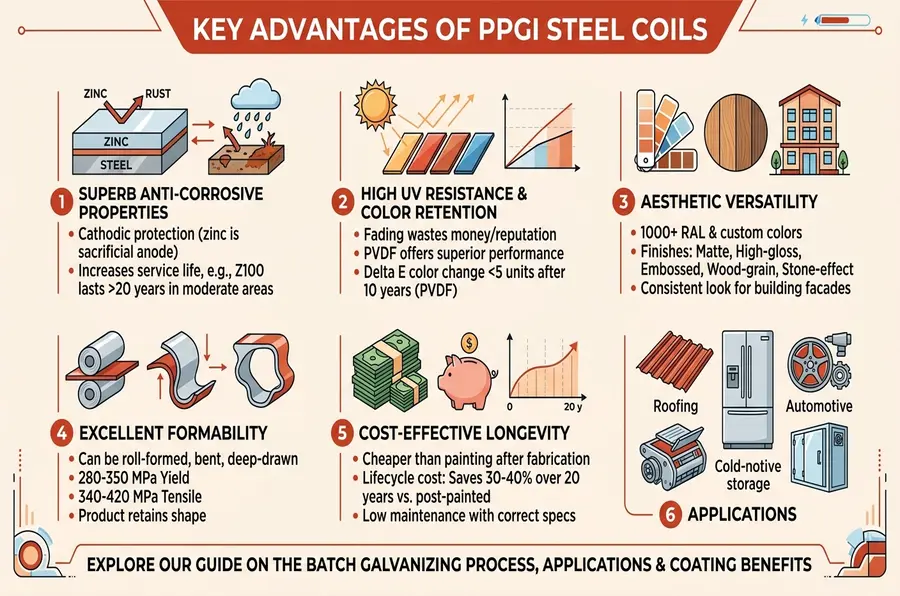
The zinc layer is the sacrificial anode. It erodes sooner than the base steel. This mechanism of anti-corrosive properties is known as cathodic protection and it increases the service life immensely. Z100 coated sheet can be used in a moderate environment and lasts more than 20 years without repainting.
HUV Resistance and Color Retention
Fading wastes money and reputation. PPGI/PVDF paint offers HUV resistance and color retention that cannot be compared to PE coatings. The Delta E colour change remains less than 5 units after 10 years of exposure to UV in PVDF-coated products. PE-coated sheets can be visibly faded in 5-7 years in a tropical climate.
Aesthetic Versatility
PPGI has more than 1,000 RAL and custom colour choices. Surface finishes consist of matte, high-gloss, embossed, wood-grain and stone-effect. It is specified by architects to give building facades the same look at scale because it provides the same look.
Excellent Formability
PPGI can be roll-formed, bent and deep-drawn without cracks in the paint. Values of yield strength and tensile strength of 280-350 MPa yield and 340-420 MPa tensile will guarantee that the product formed retains its shape when under load.
Cost-Effective Longevity
It is very expensive to paint steel following fabrication compared to ordering pre-painted coils. The lifecycle cost analysis usually indicates that PPGI is cost-effective by saving 30-40% after 20 years in comparison with post-painted options. When the appropriate spec is selected initially, the maintenance requirements are low.
These are the benefits of PPGI steel that make it the material of choice in roofing, appliances, automotive parts and cold-storage panelling.
To better understand how protective zinc coatings improve steel performance and service life, explore our guide on the Batch Galvanizing Process, Applications and Coating Benefits. It explains the galvanizing process, coating characteristics and the long-term advantages of corrosion-resistant steel.
The 2026 Buyer’s Checklist: How to Choose the Right Spec
The vast majority of purchasing errors occur at the specification level rather than at the supplier level. Before you get in touch with any PPGI steel coil manufacturers, lock in your specs. Use this checklist.
Steel Grade and Base Metal Thickness (BMT)
Specify base metal thickness (BMT) not overall thickness. BMT does not include the zinc and paint layers. The typical BMT values include 0.35 mm, 0.40 mm, 0.47 mm, 0.50 mm and 0.60 mm. Structural roofing panels normally need 0.47 mm or more. Wall panels used can be decorative with 0.35-0.40 mm.
Strength of yield is important as well. Order roofing grade, DX51D or better. In deep-drawing use DX54D or DX56D for maximum formability.
Zinc Coating Thickness (GSM)
Select a zinc coating thickness (GSM) matching your environment:
- Z60 (60 g/m²): Controlled indoor environments. Appliances, shelving.
- Z100 (100 g/m²): Standard outdoor use. Urban construction, general roofing.
- Z200 (200 g/m²): Moderate coastal or industrial environments.
- Z275 (275 g/m²): Aggressive environments. High humidity, industrial zones.
Paint Type Selection
Select your paint system depending on the exposure:
- PE (Polyester): Budget projects, shaded environments or indoor cladding.
- SMP (Silicone Modified Polyester): Mid-range industrial roofing where heat matters.
- PVDF: Coastal locations, high-UV climates or landmark buildings requiring 25-year colour guarantees.
Coil Dimensions and Tolerances
Indicate coil width (usually 750 mm-1250 mm), inner diameter (508 mm or 610 mm) and maximum coil weight. Roll-forming lines are very sensitive to tight width tolerances (±1 mm). Slack tolerances result in wastage of materials and jamming of machines.
How to Choose Reliable PPGI Steel Coil Manufacturers?
Not every PGI steel coil manufacturer does the same. In the international market, there are world mills and low-grade mills. The price difference between them can look deceptively small but the quality gap is enormous.
Red Flags to Avoid
- Unusually low prices: A below-market quote of 15-20% nearly always indicates a coating of zinc below-thin, poor quality paint or recycled base steel.
- No mill test certificates (MTC): All legitimate heats of steel are accompanied by a traceable MTC. Any shipment without one is refused.
- Vague coating weight claims: No longer a range of values such as standard galvanised.
- Poor packaging: Inappropriate packaging is one of the major reasons that lead to the rusting of coils. Coils in VCL film and waterproof paper are wrapped in quality mills.
Vetting Criteria for Qualified Suppliers
- Certifications: Check ISO 9001, ISO 14001, SGS, BV or CE marking. These are published by Tier-1 mills.
- Mill Test Certificates: Request MTCs with chemical composition, mechanical properties, coating weight and paint thickness. Compare the findings with the order spec.
- Reference Clients: Ask for three verifiable client references in your industry. A genuine manufacturer will provide them without hesitation.
- Inspection Options: Check whether the supplier permits third-party pre-shipment inspection (PSI). This is a non-negotiable requirement for large orders.
- Production Capacity: Match capacity to your volume. A supplier producing 5,000 MT/month cannot reliably serve a 2,000 MT/month buyer while maintaining quality.
In the case of sourcing specialty steel products, you can consider visiting a reputable manufacturer of stainless steel and other PPGI suppliers to be in a position to assess the credibility of suppliers and their manufacturing standards.
Conclusion: Make Your PPGI Investment Work
A smart PPGI steel coil buy does not entail the lowest price. It is concerned with finding the correct specification for your project environment. Bad quality of zinc in a project at the coast-coil fails after 3 years. Incorrect paint kind in extreme UV light colors dry out in five. Right spec, right supplier, and the product works for decades.
Our work with buyers at Four Steels is through all levels, such as spec selection up to final inspection. You can get our standard PE-coated coils, or you can get our higher-quality PVDF-finished stock with detailed technical advice and mill-direct prices.
Post your project requirements below. Or get a personal quote of the PPGI steel coil by directly calling the Four Steels sales department to design a custom coil to fit your application, climate and volume.
Frequently Asked Question
What is the average thickness of PPGI steel coil used in roofing?
A base metal thickness (BMT) of 0.40 mm to 0.60 mm is most frequently used in roofing applications, whereas 0.50 to 0.60 mm is used in structural purlins and other high-duty industrial roofing. The finer gauges (0.35-0.40 mm) are used in the lightweight panels and wall cladding materials. Always order BMT and not total thickness.
What is the difference between PPGI and PPGL?
PPGI uses a 100% zinc (hot-dip galvanized) substrate. PPGL is made with a Galvalume substrate, an aluminium-zinc alloy that has approximately 55% aluminium, 43.4% zinc, and 1.6% silicon. In open and coastal environments, PPGL has excellent corrosion resistance. PPGI offers enhanced state-of-the-art protection and is more affordable when it comes to customary construction projects.
What paint coating would you recommend: PE, SMP or PVDF?
Select PE (polyester) where the important consideration is cost, and the application is indoor or sheltered. Use SMP (silicone modified polyester) in industrial roofing that needs to be more heat-resistant than PE. Use PVDF in projects where the color is required to last 20-30 years of color retention in heavy UV conditions, coastal buildings, tropical climate or landmark facades.
How can I check the weight of zinc coating on a coil of PPGI?
Order the mill test certificate (MTC) of each coil heat. The coating weight on the MTC is given in grams per square meter (GSM) of the two sides with the coating. A third-party lab report can also be requested with the triple spot test or single spot test as per ASTM A90 or ISO 1460.
Which packaging do I need to order when shipping PPGI steel coils by sea?
The major sources of coil rust during transit are seawater and condensation. Mandate wrapping of coils in VCI (Volatile Corrosion Inhibitor) film, coated with waterproof kraft paper, and steel or PET strapping. To avoid ingress of moisture, the inner eye of the coil must be plugged. The coil base is safeguarded by outer wooden or steel pallets to avoid damage during forklift handling.