

Procurement errors in industrial metals cost US manufacturers between $40,000 and $250,000 per incident, and that’s before factoring in assembly delays or field failures. You can avoid those losses with some proven strategies.
The 2026 procurement landscape is unforgiving. Global supply chains are still showing the aftershocks of the ongoing geopolitical tensions, including trade disruptions tied to the Russia-Ukraine conflict and strained US-China trade dynamics. Raw material costs for nickel, which is a core alloying element, increased again in early 2026, pushing stainless steel prices roughly 12–18% above their 2023 baseline. Every sourcing mistake you make in this environment hits harder.
So whether you’re purchasing a stainless steel plate for a structural application, stainless steel sheet for a precision enclosure, or stainless steel bar for a machined component, this guide covers the 10 most expensive mistakes procurement managers make, and how to avoid them.
What is Stainless Steel?
Stainless steel isn’t a single material; it’s a family of iron-based alloys defined by a minimum chromium content of 10.5%. That chromium reacts with oxygen to form a passive oxide layer, which is what gives stainless steel its corrosion resistance. And when you add nickel, you improve formability. Similarly, when teams add molybdenum, they block localized pitting in chloride-rich environments.
The 3 Common Structural Families of Stainless Steel
The three structural types of steel families you’ll encounter most in industrial purchasing include:
- Austenitic
- Ferritic
- Martensitic
See the specifications below!
| Family | Use | Specifics |
| Austenitic (300 series) | Commonly used in the market | Non-magneticExcellent corrosion resistanceHighly formable |
| Ferritic (400 series) | Best for lower-stress and dry environments | MagneticModerate corrosion resistanceCost-effective |
| Martensitic (400 series, high-carbon) | Used for blades, fasteners, and wear-prone parts | High hardness and strengthLimited chemical resistance |
Plate vs. Sheet vs. Bar
These three form factors aren’t interchangeable, even when they’re made from the same stainless steel grades. The dimensional split means a lot because it relates to thickness tolerance, edge condition, and ultimately, how the material performs under load or fabrication.
- Plates: They start at 6mm (0.1875 inches) and above, and handle structural load, pressure vessels, and heavy fabrication.
- Sheets: They fall below 6mm and are intended for precision bending, architectural cladding, food processing surfaces, and any application where tighter thickness tolerances matter.
- Bars: They come in solid profiles in round, square, flat, or hexagonal shapes, and serve as feedstock for machining, fasteners, and structural framing.
Explore more about them below!
| Form Factor | Standard Thickness Range | Common Edge Type | Primary Industry Use |
| Plate | 6mm (0.1875″) and above | MillShearedPlasma | Structural, Pressure Vessels, Heavy Fabrication |
| Sheet | Under 6mm (0.006″–0.1875″) | Mill EdgeSlit Edge | Enclosures, Food Processing, Architectural Cladding |
| Bar (Round) | Ø3mm – Ø300mm+ | Hot RolledCold Drawn | Machined Parts, Shafts, Fastener Blanks |
| Bar (Flat) | 3mm–50mm thick, up to 200mm wide | Hot RolledCold Drawn | Frames, Brackets, Support Structures |
| Bar (Hex) | Across-flats 5mm–100mm | Cold Drawn | Fasteners, Valve Bodies, CNC Turned Parts |
Top 10 Sourcing Mistakes and How to Avoid Them
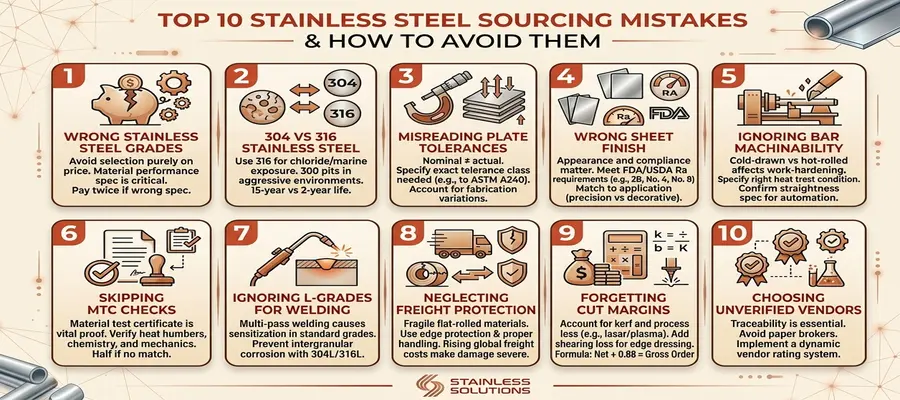
1. Wrong Stainless Steel Grades
Grade selection driven purely by unit price is the most expensive mistake in this industry. You’re not buying a commodity; you’re buying a material performance spec. And picking the wrong spec means you’re paying twice: once for the purchase and once for the replacement.
304 vs 316 Stainless Steel
This is the single most common mix-up in US procurement. Grade 304 contains 18% chromium and 8% nickel. It handles general atmospheric corrosion well. But put it in a marine environment, a coastal chemical plant, or anywhere with chloride exposure, and it will pit. Grade 316 adds 2–3% molybdenum, which dramatically improves resistance to pitting and crevice corrosion in those exact environments.
The cost difference is roughly 20–30% per pound, but the 304 vs 316 stainless steel decision could mean a 2-year service life vs. a 15-year one.
| Grade | Alloying Elements | Corrosion Resistance | Weldability | Cost ($/lb est.) |
| 304 | 18% Cr 8% Ni | Good, general atmospheric | Good (use 308L filler) | $1.40–$1.80 |
| 316 | 16% Cr 10% Ni 2% Mo | Superior, chloride/marine | Good (use 316L filler) | $1.80–$2.40 |
| 304L | 18% Cr 8% Ni <0.03% C | Good, same as 304 | Excellent, no sensitization | $1.45–$1.90 |
| 316L | 16% Cr 10% Ni 2% Mo <0.03% C | Superior, same as 316 | Excellent | $1.90–$2.50 |
| 430 | 16–18% Cr No Ni | Moderate, dry environments | Fair | $0.80–$1.10 |
| 201 | 16–18% Cr 3.5–5.5% Ni Mn | Fair, limited environments | Fair | $0.90–$1.20 |
Note: Price estimates reflect early 2026 US market conditions. War-driven nickel supply constraints and elevated energy costs continue to keep 316-series grades elevated above pre-2022 baselines.
2. Misreading Plate Tolerances
Nominal thickness is not actual thickness. This trips up even experienced procurement teams. ASTM A240, which is the governing standard for flat-rolled stainless steel plate, permits thickness tolerances that vary by width and thickness range. A 3/8″ plate ordered to A240 can come in anywhere from 0.342″ to 0.395″ in actual thickness.
That 0.05″ variation doesn’t sound like much until it hits your CNC cutting table or pressure vessel weld seam. For structural stainless steel plate applications, always specify the exact tolerance class you need. And if you’re feeding an automated fabrication line, request certified mill reports confirming actual measured thickness at multiple points across the coil or plate.
ASME standards add another point: if your plate is destined for a pressure-rated vessel, ASME B16 and ASME Section VIII Div. 1 impose additional minimum thickness requirements after corrosion allowance is factored in. Order to the calculated minimum, not the nominal.
3. Wrong Sheet Finish
Ordering a stainless steel sheet with the wrong finish doesn’t just affect appearance; it can also disqualify your material from use entirely. The FDA and USDA have established strict roughness requirements for food-contact surfaces.
A 2B finish (cold-rolled, bright annealed, skin-passed) is the most common general-purpose finish and offers Ra values normally between 0.1–0.5 µm. A No. 4 finish (brushed, directional grain) falls Ra 0.2 µm to 0.8 µm and is the go-to for commercial kitchen equipment and elevator panels. Mirror finish (No. 8) achieves Ra below 0.05 µm and is reserved for decorative architectural panels, semiconductor equipment, and pharmaceutical vessels where bacterial adhesion must be minimized.
Remember that the wrong finish affects cold-rolled vs. hot-rolled selection: hot-rolled sheet has a dull, scaled surface and is normally used for structural applications where aesthetics don’t matter. However, a cold-rolled sheet has tighter dimensional tolerances and a cleaner surface, making it what you need for precision bending and decorative work.
4. Ignoring Bar Machinability
Not all stainless steel bars feed through a CNC machine the same way. Austenitic grades, particularly 304 and 316 round bar, work-harden rapidly during machining. If your toolpaths aren’t optimized for this, you’ll shatter carbide inserts and burn through stock.
The solution is simple: First, specify the right heat treatment condition for your bar. Cold-drawn bars have tighter dimensional tolerance and better surface finish, but higher hardness. A hot-rolled bar is easier to machine but has looser tolerances. Second, confirm the straightness specification. ASTM A484 permits a standard straightness tolerance of 1/8″ per 5 feet for most bar sizes, but if you’re running 12-foot bars through an automated lathe, you need to call out a tighter spec. A 304 flat bar or hex bar supplied to the wrong straightness tolerance will cause tool chatter, alignment errors, and scrap rates that quietly destroy your margins.
5. Skipping MTC Checks
A Mill Test Certificate isn’t paperwork. It’s the only legally defensible proof that the material you received matches what you ordered. Every MTC should contain:
- The heat number (linking the material to a specific melt batch)
- The chemical composition analysis
- The mechanical test results (tensile, yield, elongation)
- And the applicable standard (ASTM A240, A276, A484, etc.)
Remember to implement a verification step: cross-reference the heat number on the MTC with the physical stamp or stencil on the material itself. If the heat number on the cert doesn’t match the stamp on the bar or plate, stop.
6. Ignoring L-Grades for Welding
A frequently overlooked mistake occurs during welding: when welding standard 304 or 316, the heat from multi-pass welding drives the carbon in the alloy to migrate to the grain boundaries. It combines with chromium there, forming chromium carbides. The result is a chromium-depleted zone adjacent to each weld pass (a condition called sensitization) that is more vulnerable to intergranular corrosion.
The solution is simple: specify 304L or 316L for any application involving extensive welding. The ‘L’ designation means carbon content is capped at 0.03% (vs. 0.08% in standard grades), which prevents carbide precipitation during welding. The mechanical properties are essentially the same. The price premium is minimal. And you eliminate a failure mode that can corrode through a weld HAZ in under 2 years in an aggressive environment.
7. Neglecting Freight Protection
Flat-rolled stainless steel sheets and plates are uniquely vulnerable in transit. A coil of mirror-finish sheet with an unprotected edge arriving at your facility with corner dents or surface scratches isn’t just aesthetically damaged, it’s scrapped. And in 2026, with freight costs rising due to fuel surcharges tied to ongoing global conflict and port congestion, damaged material is a double loss.
See more in the table below!
| Product Category | Required Protection | Purpose |
| Sheet (mirror/No.4 finish) | Interleave paper or PE film between sheets; foam corner protectors | Prevent surface scratching and edge dents |
| Sheet (2B/HR finish) | Wooden pallet with edge boards; shrink-wrap bundle | Prevent deformation under stack weight |
| Plate (heavy gauge) | Steel cradle or timber skids; banding with edge guards | Prevent sagging, warping under own weight |
| Round Bar | Bundled in a hexagonal pack; both ends capped | Prevent end-brooming and surface contact damage |
| Flat/Hex Bar | Bundled, banded, and wrapped; stored horizontal on a flat surface | Prevent bowing and edge damage during load shifts |
Suggestion: Always request a packing list with transit protection specifications before your order ships. A stainless steel supplier who can’t provide this detail is telling you something important about their quality.
8. Focusing on the Low Price
Buying unverified material to save 15% upfront often costs 300–400% of those savings in downstream consequences.
| Scenario | Upfront Material Cost | Downstream Cost If Wrong | Total Exposure |
| Verified grade 316L plate (certified MTC, known mill) | $8,500 for 2,000 lbs | $0 downstream | $8,500 |
| Unverified ‘316L’ plate (broker, no traceability) | $6,800 for 2,000 lbs | $35,000–$80,000 (field failure, rework, liability, line downtime) | $41,800–$86,800 |
| Low-grade substitute (misrepresented grade) | $5,200 for 2,000 lbs | $90,000–$250,000+ (structural failure, regulatory action, project delay) | $95,200–$255,200+ |
Note: The war-driven commodity volatility of 2025–2026 has made the unverified supply chain more dangerous. Opportunistic brokers entered the market when prices increased, and some are still there. Industrial-grade material has lifetime value, and that value only holds when the material is what it claims to be.
9. Forgetting Cut Margins
Suppose you spec out your net part sizes, calculate total square footage, and place your order. Then your laser operator calls: there’s not enough material. Why? Because nobody accounted for the kerf.
- Laser cutting removes approximately 0.006″ to 0.012″ of material per cut for stainless steel sheet, depending on power and thickness.
- Plasma cutting removes 0.060″ to 0.120″ per cut.
On a tight nesting layout with 50+ parts, those losses compound fast. Add shearing loss for edge dressing, and your actual yield from a given stainless steel plate or stainless steel sheet order is normally 85–92% of gross area.
The formula that protects your order quantity:
Net Required Area ÷ 0.88 (assuming 12% process loss) = Gross Order Quantity
Adjust the 0.88 factor based on your specific cutting process and nesting efficiency. This single calculation prevents the most common re-order scenario in fabrication shops.
10. Choosing Unverified Vendors
Paper brokers, including distributors with no physical inventory, no testing capability, and no real supply chain traceability, are a persistent problem in the US stainless steel market. They compete on price because they have no infrastructure costs. And when something goes wrong, they disappear.
Below is a table with some questions that will help you choose the right vendor.
| Question | What to Look for? | Red Flags |
| Do you hold physical inventory? | Warehouse addressPhotosStock list on request | “We source to order” with no yard details |
| Can you provide MTCs from the original mill? | CMTR traceable to named mill (e.g., Outokumpu, Acerinox, Aperam) | Certs from unnamed or unverifiable sources |
| What are your QC procedures? | Documented incoming inspectionPMI testing capabilityHardness verification | “We trust our suppliers” with no documented process |
| What lead times can you guarantee? | Published lead time commitments with carrier partnerships | Vague promises with no carrier or logistics details |
| Do you carry product liability insurance? | Certificate of insurance on request | Refusal or deflection when asked |
| Can you provide references from US industrial clients? | Named references in your industry segment | Only generic testimonials with no contact info |
Note: A legitimate stainless steel supplier answers all 6 questions without hesitation. Use this framework before placing any order over $5,000.
Conclusion
Every mistake has one root cause: treating stainless steel as a commodity when it’s actually an engineered material decision. Grade selection, tolerance compliance, MTC traceability, weld-grade specification, and vendor verification decide which projects will perform well.
The 2026 procurement environment adds an extra layer of pressure. War-driven supply volatility, elevated nickel prices, and opportunistic intermediaries in the market all raise the stakes for every sourcing decision you make. The procurement managers who build systems around these 10 checkpoints are protecting projects along with their margins, reputations, and clients.
If you want a stainless steel supplier who can answer every one of those screening questions, and back it up with certified material, documented QC, and actual inventory, Four Steels is built for exactly that. Upload your technical spec sheet to our site and receive a certified, verified quote on performance-tested plates, sheets, and bars. No brokers. No guesswork. Just traceable, engineered stainless steel delivered to spec.
Frequently Asked Questions
What is the 304 vs 316 cost difference?
In the US market as of early 2026, 316 stainless steel carries a 20–30% price premium over 304 per pound, primarily due to its molybdenum content. For a marine, chemical, or coastal application, that premium pays for itself within the first 18–24 months by eliminating pitting-driven maintenance and replacement costs.
What does MTC verification actually involve?
A proper MTC check has three steps.
- First, confirm the document references the correct ASTM standard for your product (A240 for plate/sheet, A276 or A484 for bar).
- Second, verify that the chemical composition and mechanical properties meet your grade spec.
- Third, and most critically, match the heat number printed on the cert to the physical heat number stamped or stenciled on the actual material. If they don’t match, don’t use the material.
When is 304L required instead of 304?
Specify 304L any time your application involves multi-pass welding, high heat input, or service in a corrosive environment post-weld. The low-carbon chemistry (max 0.03% C) prevents chromium carbide precipitation in the heat-affected zone, eliminating sensitization-driven intergranular corrosion. If your application is non-welded or involves only light tack welds, standard 304 is acceptable.
How do I calculate the order quantity for laser-cut parts?
Start with your total net part area from your nesting layout. Divide that figure by 0.88 to account for a typical 12% process loss from kerf, edge trim, and shearing. Then add 5% additional buffer for any remnants your fabricator flags as unusable.
What’s the fastest way to verify a supplier isn’t a broker?
Ask for three things simultaneously:
- A physical warehouse address (not just a registered office)
- A current stock inventory list for the grade and size you need
- And a sample MTC from a recent shipment, with the originating mill named.
A legitimate stainless steel manufacturer or established service center provides all three within 24 hours. However, a broker mostly stalls, deflects, or provides documents from intermediaries rather than source mills.