Steel is tough, but one thing it does not prefer is corrosion. All of the builders, fabricators, and engineers are aware of how fast untreated steel can be consumed by moisture, oxygen, and time. This is where galvanization comes in, a process that coats the metal with a protective layer of zinc to prevent rust, oxidation, and adverse weather conditions.
The Difference Between Pre-galvanized and Hot-dip Galvanized Steel has proven to be a hot topic in the construction and infrastructure projects around the globe today. With increased industries and the desire to use long-lasting materials, the choice of galvanizing technique can be seen to influence not only the performance but also cost, maintenance, and even appearance.
Both pre-galvanizing and hot-dip galvanizing have one similarity, which is to provide steel protection against decay, but the methods by which they do this vary. One occurs during the production, the other after fabrication. The former is speedy and smooth, the latter deep and durable. This distinction can be everything when it comes to structural steel elements, steel products, and building structures that have to endure decades of wear, rain, and sunshine.
At Foursteels, it is a common question when clients come in and seek to know what to use on their site: pre-galvanized or hot-dipped.
This depends on the location as well as the lifestyle of the steel. Indoor fittings? Light-duty use? Or heavy outdoor exposure?
The correct galvanizing procedure can make or break the long-term performance of your materials.
To really gain insight into what makes them special, we shall take a closer examination of the Pre-galvanized Steel Process, the manner in which it works, when it is required, and what helps it stand out amongst the other galvanizing processes, which is known as the hot-dip process, in real-life scenarios.
Understanding the Galvanizing Process
We are going to compare the two forms of galvanization, but first of all, we are going to delve into the fundamentals of how steel is truly prepared against corrosion. Galvanizing is an old technology in which a zinc coating is sprayed onto steel, creating a durable protective layer that prevents moisture and oxygen access. This is a simple yet effective coating that will ensure that rust does not form and substantially delays the process of natural oxidation that leads to weakening of steel with time.
Fundamentally, galvanizing is more than a paint or surface coating. It is a metallurgical connection, a chemical bond that is created as molten zinc is mixed with iron in the steel surface, forming strongly bonded layers of zinc-iron alloy. These alloy coating layers guarantee a firm adhesion of the coating and hence the zinc will not easily flake, peel, or wear off despite the heavy usage or extreme weather conditions.
This can be done by several methods that are appropriate to the needs of a project. Others, such as continuous or in-line galvanizing, occur during the manufacturing process of steel sheets or coils. Other ones, such as Hot Dipped Galvanized steel Process, come after fabrication and involve putting the complete structure of steel in a meltdown of zinc to cover the whole structure completely. This depends on the level of thickness and durability required for the coating, and the type of exposure to be experienced by the steel in practice.
According to ISO 1461 standards at Four Steels, we also source and process our galvanized products under controlled coating thickness and metallurgical bonding.
We inspect the coating of every piece of steel; the materials that are delivered to our clients have maximum resistance to wear and corrosion. To put it short, the galvanizing procedure converts the plain steel into an enduring, low-maintenance material that resists time, rain, and air. It is what makes bridges steady, fences gleaming, and industrial buildings firm and strong, all due to that one thin and yet mighty coating of zinc.
What Is Pre-galvanizing?
The pre-galvanization process can be used to protect steel even before it assumes its final form as a beam, post, or bracket. This technique layers the steel prior to any cutting, welding, or joining taking place. It is quick, effective, and it is used in the large-scale production of steel, whereby meters of steel materials are run across continuous galvanizing lines every day.
The Process: In-line or Mill Galvanizing.
Pre-galvanizing (also known as in-line galvanizing or mill galvanizing) occurs right at the steel mill. The steel that is typically in the shape of a flat coil or sheet is continuously sent through a cleaning system and then sent into a molten bath of zinc. After coating, the sheet is blown off using air knives to remove excess zinc to attain fine coating uniformity.
To know more about the production process of these coils, you may refer to galvanized coils produced through continuous processes, which describes the finer details of in-line coating and cooling.
Where It’s Commonly Used
Applications of pre-galvanized steel are normally those that initially start as flat materials, such as steel coils and sheets, which are later formed into ducts, cable trays, support channels, or enclosures. Since the coating is done before fabrication, it is a great option for those parts that do not need much welding and post-cutting.
The coating, however, being thinner than that of post-fabrication hot-dip galvanizing, is not extraordinarily durable, but instead, it is moderate. When the steel is cut or drilled, the bare surfaces are not coated and thus may be susceptible to corrosion unless treated accordingly.
Why Industries Use It
The pre-galvanized steel is popular with manufacturers due to its affordability, polished surface, and speed of manufacturing. The smooth surface can be painted or powder-coated easily, and the uniform thickness facilitates quality control in large batches. It is also more eco- friendly, as the continuous lines will reduce waste and maximize energy consumption.
Overall, pre-galvanizing is everything related to efficiency and the finish of the surface. It is the preferred option when you have to have attractive steel, works in low to moderate exposure, and fits into the fast-paced manufacturing process with ease.
What Is Hot-dip Galvanizing?
When pre-galvanizing is concerned with speed and surface finish, it is hot-dip galvanizing that follows concerning strength and endurance. It is the procedure that occurs once the steel product has been completely made, that is, the structure has been cut, welded, and assembled initially, and then covered up. This is one of the reasons why hot-dip is referred to as a batch galvanizing process, because the finished work is individually treated but not in continuous lines.
The completed steel is dipped in a hot bath of zinc to approximately 450 °C. It is in this step that an interesting chemical process takes place, in the sense that the iron in the steel reacts with the molten zinc to create several layers of zinc-iron alloy. Such a reaction forms a good metallurgical bond, much tougher than any surface coating or paint can ever offer.
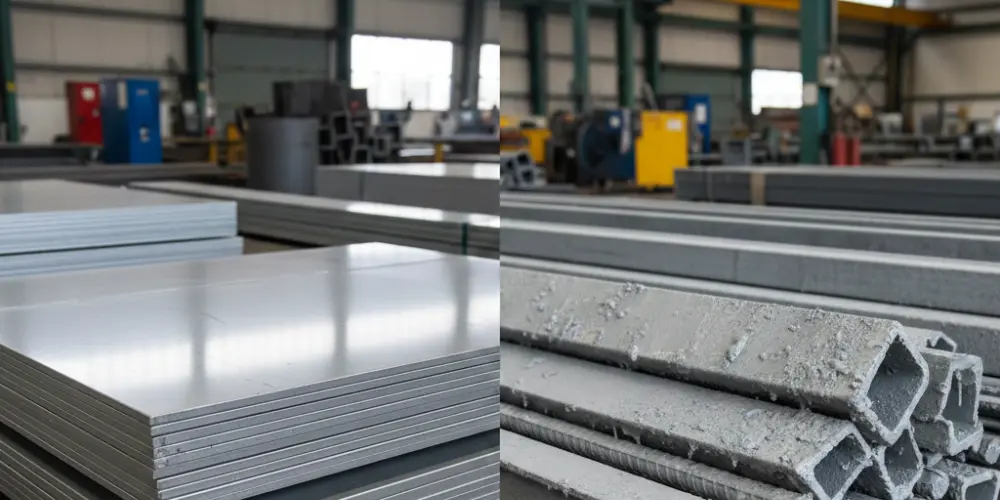
As the steel comes out of the zinc bath, it presents a solid, firmly bonded layer that adheres to all the surfaces of corners, welds, cut edges, and even the tiniest crevices. Such uniform coverage guarantees good adhesion of the coating and durability against corrosion. The outcome is a silver-gray finish that tends to show a characteristic crystalline spangle-like pattern, a visible residue of complete zinc incorporation.
At Four Steels, we are applying high-grade materials like DX51D hot-dip galvanized steel when it comes to work that requires outstanding resistance and reliability. The galvanizing associates we work with comply with the rigid EN ISO and ISO 1461 standards and ensure that all of the beams, channels, and supports are of an appropriate quality required in contemporary construction.
Essentially, galvanizing the hot dip turns the steel into a shield against time, moisture, and wear. It is the way to go when engineers and builders require long-term performance, the type that can resist extreme elements, exposure to the sea, and other industrial purposes, and still maintain its power and integrity.
Pre-galvanized vs Hot-dipped Galvanized — Detailed Comparison
Now we understand the way both methods work, and it is time to compare them with each other. Pre-galvanized versus Hot-dipped Galvanized steel are primarily differentiated by the process of coating, the durability of their coating, and their capacity to perform in the long run.
Pre-galvanized steel, produced through continuous lines, offers a neat appearance and consistent coating uniformity on the surface suitable for indoor fittings, ducting, and light structures. Hot-dip galvanizing, in contrast, provides a coating that is much thicker and denser and is much more resistant to abrasion, moisture, and exposure to chemicals.
Below is a simple comparison that shows how they differ across key performance factors:
| Feature | Pre-galvanized Steel | Hot-dip Galvanized Steel |
| Process Type | Continuous / In-line / Mill Galvanizing (before fabrication) | Batch Galvanizing (after fabrication) |
| Coating Thickness | Thin (≈15–25 μm) | Thick (≥55 μm, up to 85 μm or more) |
| Surface Uniformity | Very smooth and shiny | Slightly textured, may show spangle pattern |
| Coating Adhesion | Moderate, can be affected by welding or cutting | Excellent due to metallurgical bond |
| Corrosion Resistance | Suitable for mild indoor conditions | Outstanding for outdoor and industrial exposure |
| Maintenance | May need edge touch-ups and coatings | Minimal maintenance over decades |
| Cost | Lower upfront cost | Higher initial cost but longer lifespan |
| Best Use | Indoor structures, ducts, and fixtures | Outdoor projects, coastal areas, infrastructure |
Hot-dip galvanizing has a more complete protective layer, covering the whole structure, even the welds, corners, and interior. Pre-galvanizing, on the other hand, is done on the outer part of the material prior to the cutting or fabrication of the material. Hence, hot-dip has become a popular choice with structural steel sections, fence panels, M and E supports, and structural frameworks in which exposure to severe weather is inevitable.
In deciding between the two, you must always remember to consider [coating quality in galvanized steel sheets]. The quality, depth, and uniformity of the zinc layer are the main indicators of how many years your steel will last without corrosion or repairs.
Thickness and Durability of Coating.
Coating thickness becomes the most important factor when it comes to the comparison of durability. The thicker the zinc coating, the longer the steel remains covered; that is all. A heavy coating is a type of protective layer on the blade that serves as a sacrificial guard as well as a shield, being more resistant to abrasion and also more durable to extreme environments like humidity, salt, or even high and low temperature changes.
Galvanizeit.org claims that even under industrial conditions, ahot-dip galvanized steel with a coating of≥¼ inch can last 72-73 years before needing any maintenance.
That would be almost a lifetime protection. Comparatively, pre-galvanized steel will tend to need touch-ups, repainting, or replacement way earlier, particularly in areas where cut edges and ends are exposed
We assist our clients in selecting the appropriate coating to apply to their surroundings and usage. Whether it is light-duty indoor assembly or massive infrastructure that must withstand the sea winds, we make sure that all products have the appropriate standard of protection, performance, and feasibility.
Resistance to Corrosion under Various Conditions.
It is when the galvanized steel is out in the field without protection against sun, rain, humidity, and pollution that it is truly tested. Corrosion resistance is not merely the thickness of the zinc plating, but also the location of the usage of the steel. The metal stress varies in all environments, including the relatively gentle indoor air and the extreme, hostile salt spray in coastal settings.
Hot-dip galvanized steel is very good to work in conditions where high performance is required since the zinc coating only wears slowly and evenly. The surface is exposed to a stable layer of zinc carbonate that is formed by the weather resistance of the coating to prevent further oxidation. This is a natural process that allows the small scratches to be self-repaired using the hot-dip coating, and provides long-term rust resistance even when constantly exposed.
As per galvanizeit.org, the rate of corrosion of zinc in the atmosphere of ISO C3 environments, which are moderate urban or coastal environments, is between 0.7 and 2.1 um/year, which gives it about47 to 143 years of life before it needs to be maintained.
That is almost a hundred years of stable operation in standard industrial conditions and in humid locations. Nonetheless, the rate of corrosion is highly dissimilar based on the location. The same source states that the average rate of zinc corrosion is approximately 1.6 um/year in Los Angeles; however, temperatures in Abu Dhabi are higher, and metals are exposed to salt and moisture, which increases the corrosion rate up to 5 um/year. These statistics underscore the importance of the location of the project and the environment as a determinant of the selection between pre-galvanized and hot-dip.
As an illustration, the steel structures in a coastal setting or the area around marine air usually require the use of hot-dip galvanizing because the coating is thick and firmly bonded. Conversely, pre-galvanized steel may perform well in interior applications or sheltered places.
At Four Steels, the customers will consider these site-specific issues before deciding on materials. Starting with indoor structures all the way out to the marine installations, we have products like galvanized pipes for outdoor use that are made to provide the dependability in weathering and provide extensive corrosion protection even though the climate may dictate the selection.
It is important to know your environment when it comes to deciding what galvanized solution to use when performance and peace of mind are important.
Aesthetic and Surface Properties.
With respect to the selection of pre-galvanized and hot-dip galvanized steel, the visual image may be as significant as the performance. After all, the appearance of a building can be the biggest determinant of its initial impression, particularly in bare or architectural projects where finish and texture count.
The cleanliness, smoothness, and uniformity of any surface finish are usually cleaner and more even in pre-galvanized steel. The fact that it is carried through the continuous galvanizing lines makes the coating spread uniformly on the steel sheet to give a refined spangle pattern that looks uniform and controlled. This is what renders it a perfect choice in indoor applications, including ductwork, panels, or appliance frames, wherein appearance and the uniformity of surfaces are desired.
Hot-dip galvanized steel, conversely, has a slightly different tale, that of impregnability and hardiness. It is then immersed in a molten zinc bath after fabrication, which forms a thicker and rougher coating with pink spangle patterns and sometimes flow marks. Although it might not be as shiny as pre-galvanized surfaces, it has a different industrial look that conveys protection on the surface and strength. This appearance is ideal in outdoor use, such as guardrails to transmission towers, where the service life is more important than the appearance.
Here’s a quick comparison snapshot:
| Property | Pre-galvanized Steel | Hot-dip Galvanized Steel |
| Surface Finish | Smooth, even, and refined | Slightly rougher, with visible zinc flow |
| Shine | Brighter, more reflective | Matte or dull silver-gray |
| Spangle Pattern | Fine and consistent | Coarser, larger spangles |
| Coating Uniformity | Very consistent (controlled process) | Slightly varied due to manual immersion |
| Best for | Indoor or aesthetic projects | Outdoor, structural, or exposed projects |
In addition to appearances, such distinctions also influence flexibilities in fabrication. Its smooth and thin coating means that pre-galvanized steel can be bent, cut, or welded, making it more suitable for manufacturing and light construction.
Simply put, when your project requires smooth looks and a smooth feel, pre-galvanized scores the style points. But when it is made to stand the storm, the salt, and time, hot-dip galvanized steel is passing but leaving its rugged surface as a shield of its manliness.
Maintenance and Cost-effectiveness.
In making a decision between pre-galvanized and hot-dip galvanized steel, it is not only about the appearance of the surface in terms of strength and shine, but also about how long it will remain so and how much it will cost to maintain the surface in that condition.
Budget-wise, pre-galvanized steel may be cheaper to begin with. Its in-line manufacturing is quicker and more regulated, hence you save on initial expenses. Where large quantities of fabrication, such as those of M&E support, fence panels, or internal fixings, are involved, this may be a win in practice. Its thinner coating, however, may require touch-ups at cut edges and welded joints, which increases the maintenance requirement with time.
The result? Long-term savings.
The global statistics of HDGASA and StructureMag reveal that galvanized steel has a life expectancy of more than 80 years when used in coastal or rural areas and up to 120 years when buried underground.
That is not mere durability; that is peace of mind built into the metal. When you are considering the type of treatment that fits your budget and timeline, it helps to understand the different types of galvanized steel available and how each aligns with your project’s exposure, design, and maintenance goals.
The most economical galvanization in the long term is not the least expensive; it is the one that makes your structure strong and rust-free as long as possible. In that case, it places hot-dip galvanizing as the most viable choice in the long term.
Application Suitability
Various projects require various types of strength, finish, and life, which is precisely the reason why there are both pre-galvanized and hot-dip galvanized steels.
The actual question is: which of them is more suitable for your project?
Hot-dip galvanizing is ideal in the case of structures and structural steel that is subjected to heavy weather. The all-round zinc coating is thick, giving it long-lasting resistance to rust, particularly in open-air installations. Visualize bridges, warehouses, transmission poles, and heavy-duty infrastructure in any location where it will be required to withstand decades of stress, moisture, and temperature variations.
Conversely, pre-galvanized steel is bright in fabrication projects where expediency, looks, and polish are more important. It is frequently used in fence boards and posts, M&E supports and fixings, and anchors that are indoor or in low-exposure areas. It precoats prior to fabrication, which is why it is perfect on mass-produced components with fine dimensions and uniformity in coating.
When you have a project that requires galvanized steel sheets used in construction, variants of pre-galvanized tend to be economical in performance and cost. However, in the case of welded joints or structures that are exposed to rain, salt, or dust, portable hot-dip galvanized finishes are much more powerful in providing protection so that even cut edges and uncovered surfaces remain covered.
In settings where the looks and the stability are equally important, such as modern buildings or coastal facades that mix treatments, it can be a clever approach. Pre-coloured or colour-coated sheets are also used here. Studies indicate that the [performance of pre-painted galvanized sheets under harsh environments] is still amazing when supported with a good zinc base, and provides a beautiful as well as long-lasting durability to your steel parts.
Choosing the Best Option for Your Project
At this point, it is evident that both forms of galvanization are useful, but in the context of Hot-dip galvanized vs Pre-galvanized, what best fits your project is entirely determined by your environment, your design, and your objectives of the desired durability.
When you have an application where exposure is outdoors, subject to varying temperatures, or close to a coastal or industrial area, there is no better choice than hot-dip galvanized steel. The zinc coating that forms a tough protective shell makes it strong against the adverse environmental conditions, and it provides decades of corrosion resistance with the least maintenance.
Pre-galvanized steel is the best choice in the case of indoor locations or lightweight constructions where the most important feature is a smooth finish, ease of handling, and low cost. It provides effective rust resistance and great fabrication versatility, particularly in modular or prefabricated constructions.
In comparing the two, it would be convenient to see a comparison of zinc coating in terms of performance, lifespan, and the type of applications. Hot-dip coatings can generally last over 70-80 years when used outdoors, whereas pre-galvanized finishes are generally most effective in moderate climates or areas with shelter.
This is a simple real-world example; a fencing project along the coastal area of southern Pakistan needed to be resistant to salt and moisture. Engineers also chose a Z275 galvanized sheet, which had a high resistance to corrosion so that the steel panels could endure years of exposure to the sea and salinity without showing any traces of rust. This demonstrates the right galvanization decision, which is in line with its surroundings, and it will make all the difference.
When you are asking yourself how to select the galvanized steel to use in your next project, begin by looking at:
- Exposure amount: is it in-house, on the outside, or close to the seashore?
- Projected life expectancy: Temporary or long-term facilities?
- Design and fabrication requirements: Will it be welded, cut, or bent after coating?
The decision is easy once you are aware of these factors. Select pre-galvanized to speed up. Select hot-dip galvanized because of its durability and complete security.
At Four Steels, we allow our clients to strike a balance between performance and practicality so that all projects, whether fence panels or building structures, employ the best coating to achieve long-lasting outcomes.
Quality Control and Testing.
In the case of galvanized steel, the idea of quality is not only limited to shine, but also compliance, consistency, and certification. Each process stage of the galvanizing should be of international standards that will assure long-life protection and performance.
Four Steels manufactures and checks its galvanized products as per ISO 1461 and EN ISO requirements, and thus every sheet and component is produced with the specified galvanizing standard of structural and industrial applications. These standards are used not only to specify the coating thickness but also to specify the testing, inspection, and acceptance standards of durable corrosion protection.
The quality control in our galvanizing department is also in-house and used to ensure that all our products, whether pre-galvanized, hot-dipped, or a composite coating, will provide uniform rust protection and oxidation prevention even in the most challenging field conditions. In order to ensure reliability, every batch is recorded in terms of full coating certification, giving traceability between the production line and the final delivery.
To achieve high resistance, e.g., in coastal or industrial applications, we would suggest our G90 galvanized sheet with high coating thickness, which is designed to work in extreme weather and high-humidity conditions.
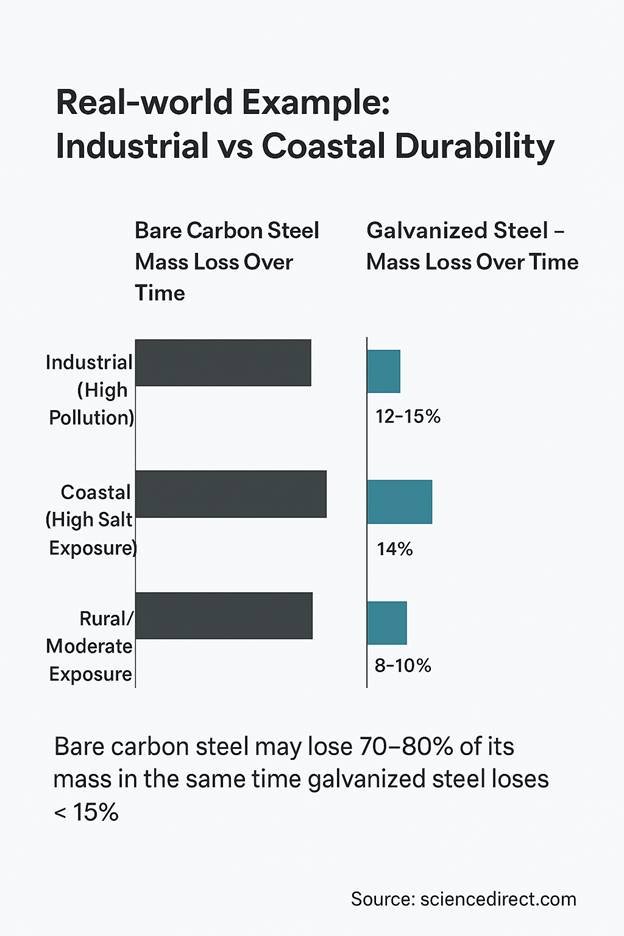
Application in the real world: Industrial vs Coastal Durability.
Corrosion protection is better addressed by numbers than theory. To demonstrate how much difference galvanizing really is, we can take a look at how steel behaves in the real-world conditions in industrial areas and extreme coastal weather.
In a study published in ScienceDirect, bare carbon steel can lose as much as 70-80 % of its mass within the same period, while galvanized steel can only lose less than 15 %..
The gap is, however, dramatic, and that is exactly the reason why galvanization is the best choice for the protection of structural steel parts that are exposed to oxygen, salt, and moisture.
These findings reinforce the fact that galvanized steel has much more structural life despite being in high-moisture or salt-rich conditions. Zinc coating is a protective layer and a sacrificial layer because it resists rust formation and increases the duration of life of the steel by decades.
In a demanding workplace like a factory, a refinery, or a construction area, a coastal factory, it is essential to select the appropriate quality of coating. The use of products such as the DX51D galvanized coil to be used in industries, which are designed to have excellent zinc-iron bonding, offers great strength and reliability required in long-term infrastructure applications.
Conclusion — Which Type Fits Your Long-term Needs?
The question of whether to use pre-galvanized or hot-dip galvanized steel is determined by the eventual location, the duration, and the methods of exposure of your project to the elements.
In case you are engaged in the manufacture of sheets and M&E supports, and indoor buildings, pre-galvanized steel presents accuracy, smooth coverings, and affordability. It is ideal for quick fabrication, hygienic looks, and regulated coating consistency, ideal for products that inhabit low-moisture or slightly humid climates.
However, when strength, endurance, and weather exposure are involved, like the construction of structures, coastal installations, or heavy infrastructure, the hot-dip galvanized steel is the obvious choice. Its heavier coating of zinc, its metallurgical bond, and complete immersion guard make it well guarded against corrosion, abrasion, and even time itself.
Both are used at the end of the day; one of them is made quickly, and the other is made strong. The improvement is achieved best by ensuring that you use the right coating based on your needs of performance and environment. Four Steels also offers pre-galvanized and hot-dip galvanized steel products that are supported by stringent quality measures and covered by ISO procedures. It might be an elaborate lie or a bare-air construction, but our crew will make sure that all the work has the appropriate shielding and will be developed to stand the test of time, layer after layer.
Frequently Asked Question
What is the difference between pre-galvanized and hot-dip galvanized steel?
Before fabrication, pre-galvanized steel (also called in-line or mill galvanized) is a type of steel that is coated with zinc in the process of equipment manufacturing to make steel sheets or coils. It is smooth, uniform, and used in mass production or indoor use.
Hot-dip galvanized steel, however, is immersed in a molten zinc bath once fabricated, which provides a heavier, more robust protective coating that covers all of the metal internally, externally, and welds.
How do you choose between pre-galvanized and hot-dip galvanized for your project?
The correct decision lies on the basis of environmental, budgetary, and performance requirements.
- Environment: In outdoor or coastal and high-humidity areas, use hot-dip galvanized steel because of its thicker and more robust coating.
- Budget & Aesthetic: When one wants to show an interior or controlled environment where non-resistance, uniform appearance is required, the pre-galvanized steel is frequently chosen.
- Maintenance & Lifecycle: Hot-dip can be maintained with minimum maintenance and can be used for several decades in a harsh environment.
How long does galvanized steel last in different environments?
The life of galvanized steel is directly related to the exposure to the environment and the thickness of the coating.
- Zinc decays in the industrial setting (ISO C3) at an average of 0.7-2.1 um each year, which provides 47-143 years of maintenance.
- Corrosion can increase to above 5 um/year in coastal or marine climates, reducing life to about 30-40 years depending on coating grade.
- Galvanized steel, when buried, can last 120 years, and the performance can be 80+ in rural areas.
Does hot-dip galvanizing protect welds, cut edges, and internal surfaces?
Yes! It is one of its greatest advantages.
In hot-dip galvanizing, all the molten zinc completely permeates and attaches itself to all surfaces, including welds, corners, and internal cavities. This guarantees continuity of coating completely and permanent protection even on complex structures.
What is the optimal coating thickness for durability?
The ISO 1461 and ASTM A123 suggest that the lifespan of corrosion protection is directly proportional to coating thickness.The common hot-dip galvanized coatings would be between 45-85 um (pre-galvanized), and are approximately 15-25 um. The denser the layer of zinc, the slower its corrosion rate (measured in um/year).
Due to the rough conditions of harsh outdoors or marine installations, long-term usage is recommended with Z275 (≈20 um) or more.
Generally speaking, each 10 um of coating will provide protection of approximately 10-15 years in typical surroundings.
Can galvanized steel be painted or coated further?
Yes! Galvanized steel may be painted or powder-coated and colored-coated to make it more attractive and add additional protection.
The surface should, however, be cleaned and pre-treated first before adhesion (called duplex coating).This is particularly popular with architectural or outside installations in which color finish and weatherproofing are a consideration, such as pre-painted galvanized sheets on a facade or a roof